This Guide is also available as a downloadable pdf and en español
On this page:
Overview
Mold Basics
Mold Cleanup
Mold Cleanup Guidelines
What to Wearable When Cleaning Moldy Areas
Is the Cleanup Complete?
Wet and Mold Prevention and Control Tips
Hidden Mold
Cleanup and Biocides
Additional Resources
Overview
This Guide provides information and guidance for homeowners and renters on how to clean upward residential mold problems and how to prevent mold growth. The content on these web pages is based on EPA'southward publication "A Brief Guide to Mold, Moisture and Your Habitation." Updates have been made to some resources and links.
Mold Nuts
The key to mold command is moisture control.
If mold is a trouble in your dwelling house, you should clean upwardly the mold promptly and gear up the water trouble.
It is important to dry water-damaged areas and items within 24-48 hours to prevent mold growth.
Why is mold growing in my dwelling?
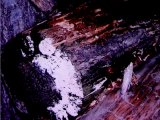
Mold growing outdoors on firewood. Molds come in many colors; both white and black molds are shown here.
Molds are part of the natural environment. Outdoors, molds play a office in nature by breaking down dead organic matter such as fallen leaves and expressionless copse, simply indoors, mold growth should be avoided. Molds reproduce past means of tiny spores; the spores are invisible to the naked eye and float through outdoor and indoor air. Mold may brainstorm growing indoors when mold spores land on surfaces that are wet. There are many types of mold, and none of them will grow without h2o or moisture.
Tin mold cause health bug?
Molds are usually not a problem indoors, unless mold spores land on a moisture or damp spot and begin growing. Molds have the potential to cause health bug. Molds produce allergens (substances that can crusade allergic reactions), irritants, and in some cases, potentially toxic substances (mycotoxins). Inhaling or touching mold or mold spores may cause allergic reactions in sensitive individuals. Allergic responses include hay fever-blazon symptoms, such as sneezing, runny olfactory organ, red optics, and skin rash (dermatitis).
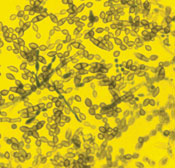
Magnified mold spores
Molds gradually destroy the things they grow on. You tin prevent impairment to your home and furnishings, save money, and avoid potential health issues by decision-making moisture and eliminating mold growth
Allergic reactions to mold are common. They can exist firsthand or delayed. Molds can also cause asthma attacks in people with asthma who are allergic to mold. In addition, mold exposure tin can irritate the optics, skin, nose, throat, and lungs of both mold-allergic and non-allergic people. Symptoms other than the allergic and irritant types are not ordinarily reported equally a result of inhaling mold. Research on mold and health effects is ongoing.
This [guidance] provides a brief overview; information technology does not draw all potential wellness furnishings related to mold exposure. For more detailed information consult a health professional. You may also wish to consult your state or local wellness department.
How do I get rid of mold?
Information technology is impossible to get rid of all mold and mold spores indoors; some mold spores will be establish floating through the air and in house dust. The mold spores will not grow if wet is non nowadays. Indoor mold growth tin and should exist prevented or controlled by controlling wet indoors. If at that place is mold growth in your home, you must make clean up the mold and fix the water problem. If you make clean up the mold, just don't fix the water problem, and then, most likely, the mold problem will come dorsum.
Mold Cleanup
If you already have a mold trouble - human action apace. Mold amercement what it grows on. The longer it grows, the more damage it tin crusade.
Who should do the cleanup depends on a number of factors. One consideration is the size of the mold problem. If the moldy area is less than most ten square feet (less than roughly a three ft. by three ft. patch), in most cases, you can handle the chore yourself, follow the guidelines. However:
If in that location has been a lot of water damage, and/or mold growth covers more than than 10 foursquare anxiety, consult EPA's Mold Remediation in Schools and Commercial Buildings. Although focused on schools and commercial buildings, this certificate is applicable to other building types.
If you choose to hire a contractor (or other professional service provider) to exercise the cleanup, brand sure the contractor has experience cleaning upwards mold. Check references and inquire the contractor to follow the recommendations in EPA's Mold Remediation in Schools and Commercial Buildings, the guidelines of the American Conference of Governmental Industrial Hygenists (ACGIH), or other guidelines from professional or government organizations.
If you suspect that the heating/ventilation/air conditioning (HVAC) arrangement may exist contaminated with mold (it is part of an identified moisture problem, for case, or at that place is mold most the intake to the system), consult EPA'due south guide Should You Have the Air Ducts in Your Home Cleaned? earlier taking further action. Do not run the HVAC system if yous know or suspect that it is contaminated with mold - it could spread mold throughout the building.
If the water and/or mold damage was caused by sewage or other contaminated water, and then call in a professional who has experience cleaning and fixing buildings damaged by contaminated water.
If you have health concerns, consult a health professional earlier starting cleanup.
Mold Cleanup Guidelines
Bathroom Tip:
Places that are often or always damp can exist difficult to maintain completely gratuitous of mold. If there'southward some mold in the shower or elsewhere in the bathroom that seems to reappear, increasing ventilation (running a fan or opening a window) and cleaning more than frequently volition usually preclude mold from recurring, or at least keep the mold to a minimum.
Tips and techniques
The tips and techniques presented in this section volition assistance you lot make clean upwards your mold trouble. Professional cleaners or remediators may use methods not covered in this publication. Please notation that mold may crusade staining and corrective damage. Information technology may non be possible to make clean an item so that its original appearance is restored.
Set up plumbing leaks and other water bug as soon as possible. Dry all items completely.
Scrub mold off hard surfaces with detergent and water, and dry out completely.
Absorptive or porous materials, such every bit ceiling tiles and carpet, may accept to exist thrown away if they get moldy. Mold can grow on or fill in the empty spaces and crevices of porous materials, so the mold may be difficult or impossible to remove completely.
Avoid exposing yourself or others to mold (see discussions: What to Wear When Cleaning Moldy Areas and Subconscious Mold).
Do not pigment or caulk moldy surfaces. Clean up the mold and dry the surfaces before painting. Paint applied over moldy surfaces is likely to peel.
If you lot are unsure almost how to clean an item, or if the item is expensive or of sentimental value, you may wish to consult a specialist. Specialists in furniture repair, restoration, painting, art restoration and conservation, carpeting and rug cleaning, water impairment, and fire or h2o restoration are commonly listed in phone books. Be sure to ask for and check references. Look for specialists who are affiliated with professional organizations.
What to Wear When Cleaning Moldy Areas
It is important to accept precautions to limit your exposure to mold and mold spores.
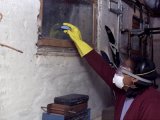
Cleaning with Personal Protective Equipment (PPE) Gloves, goggles, N-95 respirator. Avert breathing in mold or mold spores. In guild to limit your exposure to airborne mold, you may desire to wear an Due north-95 respirator, bachelor at many hardware stores and from companies that advertise on the Internet. (They cost about $12 to $25.) Some N-95 respirators resemble a paper dust mask with a nozzle on the front end, others are made primarily of plastic or safe and have removable cartridges that trap most of the mold spores from entering. In society to be effective, the respirator or mask must fit properly, then advisedly follow the instructions supplied with the respirator. Delight notation that the Occupational Safety and Health Assistants (OSHA) requires that respirators fit properly (fit testing) when used in an occupational setting; consult OSHA for more data (800-321-OSHA or osha.gov).
Wear gloves. Long gloves that extend to the center of the forearm are recommended. When working with water and a mild detergent, ordinary household prophylactic gloves may be used. If you are using a disinfectant, a biocide such as chlorine bleach, or a stiff cleaning solution, you should select gloves made from natural rubber, neoprene, nitrile, polyurethane or PVC (encounter Cleanup and Biocides). Avoid touching mold or moldy items with your bare hands.
Habiliment goggles. Goggles that do not accept ventilation holes are recommended. Avert getting mold or mold spores in your eyes.
How Do I Know When the Remediation or Cleanup is Finished?
You must have completely fixed the h2o or wet trouble before the cleanup or remediation can be considered finished.
You lot should have completed mold removal. Visible mold and moldy odors should not be present. Please note that mold may cause staining and cosmetic impairment.
You should have revisited the site(s) soon after cleanup and it should prove no signs of h2o impairment or mold growth.
People should accept been able to occupy or re-occupy the area without health complaints or physical symptoms.
Ultimately, this is a judgment call; in that location is no easy answer. If you have concerns or questions consult our Frequently Asked Questions database and ask a question if y'all don't detect what yous need.
Moisture and Mold Prevention and Control Tips
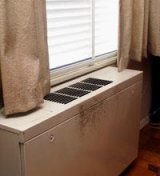
Mold growing on the surface of a unit of measurement ventilator
Moisture Control is theKey toMold Command
When water leaks or spills occur indoors -act quickly. If moisture or damp materials or areas are dried 24-48 hours later a leak or spill happens, in most cases mold will non grow.
Clean and repair roof gutters regularly.
Make certain the ground slopes away from the building foundation, then that water does not enter or collect effectually the foundation.
Keep air conditioning drip pans make clean and the drain lines unobstructed and flowing properly.
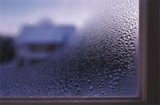
Condensation on the within of a windowpane.
Go along indoor humidity depression. If possible, continue indoor humidity below sixty percent (ideally between 30 and 50 percent) relative humidity. Relative humidity can exist measured with a moisture or humidity meter, a pocket-sized, cheap ($10-$50) instrument available at many hardware stores.
If you encounter condensation or moisture collecting on windows, walls or pipeshuman activity quickly to dry the wet surface and reduce the wet/water source. Condensation can be a sign of high humidity.
Actions that will help to reduce humidity
Vent appliances that produce moisture, such every bit apparel dryers, stoves, and kerosene heaters to the outside where possible. (Combustion appliances such as stoves and kerosene heaters produce water vapor and will increase the humidity unless vented to the outside.)
Use air conditioners and/or de-humidifiers when needed.
Run the bath fan or open the window when showering. Use exhaust fans or open windows whenever cooking, running the dishwasher or dishwashing, etc.
Actions that will help prevent condensation:
Reduce the humidity (see preceding page)
Increase ventilation or air movement by opening doors and/or windows, when applied. Use fans as needed.
Cover cold surfaces, such every bit cold water pipes, with insulation.
Increase air temperature.
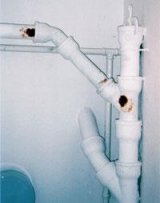
Rust is an indicator that condensation occurs on this drainpipe. The pipe should be insulated to forbid condensation.
Renters: Report all plumbing leaks and moisture problems immediately to your building owner, manager, or superintendent. In cases where persistent h2o problems are non addressed, you lot may want to contact local, state, or federal health or housing authorities. Y'all can also contact your state health department.
Test or Sampling for Mold
Is sampling for mold needed? In most cases, if visible mold growth is present, sampling is unnecessary. Since no EPA or other federal limits have been set for mold or mold spores, sampling cannot exist used to check a building's compliance with federal mold standards. Surface sampling may be useful to decide if an area has been fairly cleaned or remediated. Sampling for mold should be conducted by professionals who accept specific experience in designing mold sampling protocols, sampling methods, and interpreting results. Sample analysis should follow analytical methods recommended by the American Industrial Hygiene Association (AIHA), the American Conference of Governmental Industrial Hygienists (ACGIH), or other professional organizations.
Hidden Mold
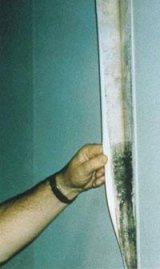
Mold growing on the back side of wallpaper.
Suspicion of hidden mold
You may doubtable subconscious mold if a building smells moldy, only you cannot see the source, or if you know there has been h2o impairment and residents are reporting health problems. Mold may be hidden in places such as the back side of dry wall, wallpaper, or paneling, the summit side of ceiling tiles, the underside of carpets and pads, etc. Other possible locations of hidden mold include areas inside walls around pipes (with leaking or condensing pipes), the surface of walls backside furniture (where condensation forms), inside ductwork, and in roof materials higher up ceiling tiles (due to roof leaks or insufficient insulation).
Investigating hidden mold bug
Investigating subconscious mold problems may be hard and will require caution when the investigation involves disturbing potential sites of mold growth. For instance, removal of wallpaper can pb to a massive release of spores if there is mold growing on the underside of the paper. If y'all believe that you may have a subconscious mold trouble, consider hiring an experienced professional person.
Cleanup and Biocides
Biocides are substances that tin can destroy living organisms. The employ of a chemic or biocide that kills organisms such every bit mold (chlorine bleach, for instance) is not recommended every bit a routine practice during mold cleanup. There may be instances, however, when professional person judgment may signal its use (for case, when immune-compromised individuals are present).
In most cases, information technology is non possible or desirable to sterilize an surface area; a groundwork level of mold spores will remain - these spores volition not grow if the moisture problem has been resolved. If you choose to use disinfectants or biocides, e'er ventilate the surface area and exhaust the air to the outdoors. Never mix chlorine bleach solution with other cleaning solutions or detergents that contain ammonia because toxic fumes could exist produced.
Please notation: Dead mold may still cause allergic reactions in some people, and then it is not plenty to simply kill the mold, it must also be removed.
Additional Resources
Acknowledgements
EPA would similar to thank Paul Ellringer, PE, CIH, for providing the photo of Mold growing on the back side of wallpaper.
Notes
Delight annotation that this document presents recommendations. EPA does not regulate mold or mold spores in indoor air



0 Response to "Does Mildew Grow Back On Drywall If Only Cleaned With Household Product"
Post a Comment