| | Care & Feeding of the Trombone 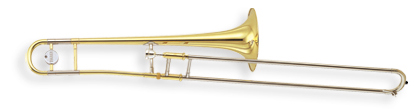 The trombone has three basic pieces: - The mouthpiece;
- The hand slide;
- The bell.
Assembly - First let's spend a moment talking about the hand slide. It comes in two pieces, the inner slide and the outer slide. As you might guess, the inner slide fits mostly inside the outer slide. The hand slide is the heart of the trombone and is very easy to damage, so we have to be careful with it at all times. A small dent anywhere in the outer slide can make the trombone harder to play.
- You'll notice that on one side of the outer slide there is a water key, commonly called a spit valve, near the bottom. The tube on this side of the outer slide is called the lower outside slide tube. The other side, with no water key, is called the upper outside slide tube.
- These two tubes, the lower and upper outside slide tubes, are joined at the bottom by the curved piece of tubing called the hand slide crook. The water key is attached to the hand slide crook on the corner where the crook connects to the lower outside slide tube.
- The outer slide tubes are joined near the top of the tubes by the outer hand slide brace.
- At the top of the upper outside slide tube, very near the outer hand slide brace, is a little strip of metal attached to the tube called the slide lock lug. It's shaped a little bit like a comma, lying on its side. This is part of a system on the hand slide that keeps the inner and outer slides safely locked together when we don't want them to move. The other part is on the inner slide.
- Just like the outer slide, there is an upper inside slide tube and a lower inside slide tube. Each tube fits inside one side of the inner hand slide brace, one on the upper and one on the lower.
- Notice that the top of one of the inner slide tubes is taller than the other and ends in a taper. This is the lower inside slide tube. The tapered portion above the inner hand slide brace is the part that connects the hand slide to the bell.
- The other tube then is obviously the upper inside slide tube. The top of this tube is where the mouthpiece goes. A little further down, just below the cross bar of the inner hand slide brace, is the other half of the slide lock assembly. The bottom of the inner hand slide brace on this side has a circular, cylindrical piece that is threaded and can be turned clockwise or counter-clockwise. Quite often there is a little piece of metal shaped like an upside down comma attached to the bottom of this piece.
- Therefore, the lower inside slide tube, the one that's longer at the top, goes in the lower outside slide tube, the one with the water key at the bottom.
- The upper inside slide tube, the one that takes the mouthpiece and has the slide lock, goes in the upper outside slide tube, the one with the slide lock lug near the top and no water key at the bottom.
- When you place the inner hand slide inside the outer hand slide be sure to have the slide lock "on" whenever you're not playing by turning or spinning the slide lock counter-clockwise until it slips over the slide lock lug to hold the outer slide in place.
Now we're ready to assemble the trombone! - The bell section starts with the bell, goes up and around and part way back down toward the bell, where it ends in the slide receiver and is secured to the long, straight part of the bell with the bell brace. At this end of the bell we can see a circular, cylindrical piece called a lock nut over the slide receiver that can be turned clockwise or counter-clockwise. The lock nut is used to secure the bell to the hand slide.
- To assemble the trombone we need to hold the bell in our left hand right by the lock nut. Hold the bell so it is facing toward the floor.
- Pick up the hand slide in your right hand and hold the lower outside slide tube just below the outer hand slide brace. Hold the hand slide straight up and down so that the end with the water key is close to the floor.
- Bring the bell and the hand slide together and insert the tapered top of the lower inside slide tube into the slide receiver. Although you are holding the trombone vertically at this point, the bell should be on the far side of your left hand, straight in front of you, and the hand slide should be at a right angle, with the upper inside slide tube where the mouthpiece goes directly to the right of the lower inner slide tube where it connects to the bell. When you have it positioned correctly you can then turn the lock nut on the slide receiver clockwise until it's snug and tight.
- Finally, gently place the mouthpiece into the mouthpiece receiver and you're ready to play!
Cleaning the Trombone Cleaning and Polishing the Outside - Just use a clean dry cloth to keep the outside of the instrument clean. There are lacquer polish cloths available that are okay to use which are treated with a wax that cleans and shines and won't hurt the finish of the trombone. If you are careful, you can also spray a polish such as Pledge® lightly on a cloth and then use the cloth to polish and remove any stubborn stains on the body of the horn.
- If the instrument is silver-plated instead of brass-lacquered, you can use a silver polish cloth to keep the outside shiny. Before you polish a silver horn, especially if you haven't given it a bath recently, take the time to wipe the outside off with a cloth lightly dampened with rubbing alcohol. This removes the oils of the perspiration from your hands and any dirt that might be on the surface and makes the actual polishing go a lot quicker.
Helpful Hints and Reminders - Pliers and trombones don't go together – ever! If your mouthpiece happens to get stuck for any reason, DO NOT use pliers to try to get it loose, and just as important, DO NOT let your dad try it either. Depending on how stuck it is, using the pliers can scratch and damage the mouthpiece at the very least, and in worse cases the hand slide can also be damaged.
- It happens very rarely, but if when you're through playing you can't separate the bell from the hand slide, if they're stuck, under NO circumstances should you try and force them apart.
- If and when the mouthpiece gets stuck, first ask your band director for help. Most band directors have a tool called a mouthpiece puller that can remove a stuck mouthpiece quickly and easily without damaging the mouthpiece or the trombone. If the band director cannot help you, then take your trombone to your local band instrument store and ask for their help.
- When you are placing the horn back in the case do not store your band method book on top of the instrument. Most trombones and trombone cases are designed these days so that padded inside of the lid comes right down on top of the trombone, leaving no room for a book. Forcing a book to fit by pushing down on the lid to close it can damage the instrument.
- Keep your trombone safe. It should only be "on your face or in the case!" Do not leave it on your chair, the sofa, the table, the floor, or the piano. If a trombone is dropped it can cause extensive damage and expensive repair.
- Always carry your case with the lid or top side of the case toward your body. This way, if the case were to unexpectedly open for any reason, you would have the chance to pull the case against your body to prevent the instrument from falling out. If the lid is facing away from you and the case opens there is no way for you to keep the instrument from falling out.
-
Whether the information is on a card inside the case, a label or an ID tag, make sure your instrument has identification on it showing that it belongs to you. Almost all band instruments have their own unique serial number on the body of the instrument so you shouldn't mark the instrument itself, but do have proof of ownership somewhere inside or on the case. | |



0 Response to "How To Deep Clean A Trombone"
Post a Comment